What's Hiding Behind Your Icons: The Science of How Wallpapers Shape What You Actually Notice

Photo by Photo by Marta Filipczyk on Unsplash on Unsplash
Most of us pick a wallpaper the same way we choose a screensaver in 1998 — quickly, emotionally, and without much thought. You see a moody mountain shot or a crisp abstract pattern, you click "Set as Desktop Background," and you forget about it. But your brain never forgets. In fact, it's processing that image constantly, making micro-decisions about where to look, what matters, and how hard to work — all before you've opened a single app.
That might sound like a stretch, but the research backing it up is pretty solid. Let's dig into what's actually happening in your head every time you sit down at your screen.
Your Brain Is Always Reading the Room
Here's the thing about human vision: it's not a camera. You don't passively record what's in front of you. Your visual cortex is constantly making predictions, filtering signals, and deciding what deserves conscious attention. Scientists call this top-down processing — your expectations and context shape what you perceive, not just the raw data hitting your retina.
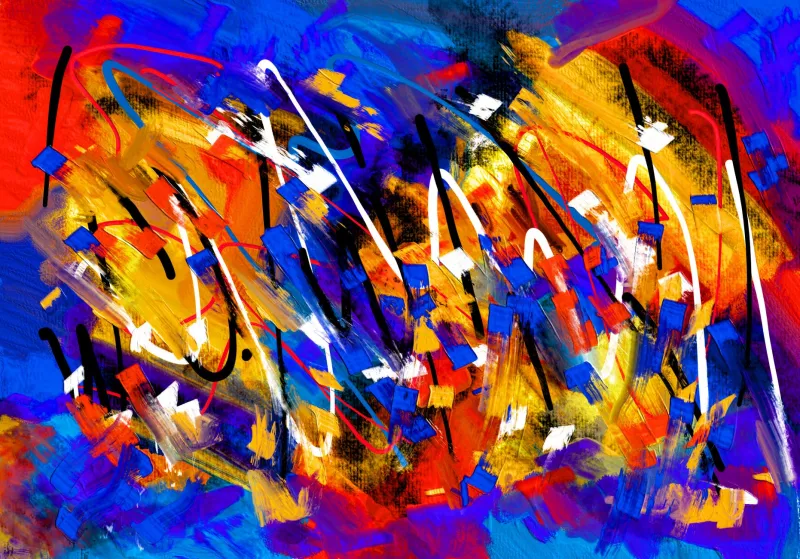
Wallpapers feed directly into that context. A background packed with high-contrast elements, intricate patterns, or lots of competing colors forces your brain to work harder to separate "signal" (your actual desktop content) from "noise" (the background). That extra effort has a name: cognitive load. And when your cognitive load is elevated before you've even clicked anything, you're already starting your workday at a deficit.
Researchers at Princeton found that visual clutter competes for neural resources in the visual cortex, reducing your ability to focus and process information. That busy wallpaper of a neon-lit Tokyo street? It looks incredible. But it might also be quietly draining you.
The Busy Background Problem
Think about what a typical desktop actually looks like in use. You've got app icons scattered across the screen, maybe a few open windows, notification badges, file folders on the desktop. Now imagine all of that sitting on top of a hyper-detailed fantasy landscape or a collage of your favorite TV show characters.
Every time you glance at your screen — even for a split second — your eyes have to re-orient. Where does the wallpaper end and the icon begin? Which notification badge is that? The brain handles this automatically, sure, but "automatically" doesn't mean "for free." Cognitive resources are finite, and decision fatigue is real. Studies on decision fatigue (most famously applied to judges making parole decisions) show that the more micro-decisions your brain makes throughout the day, the worse your judgment gets by afternoon.
Busy wallpapers stack the deck against you by front-loading that cognitive work from the moment you unlock your screen.
Strategic Imagery: When a Wallpaper Actually Works For You
Flip the script, and things get interesting. Just as a cluttered background can sap attention, a thoughtfully chosen one can subtly direct it.
Designers and UX researchers have long understood that the human eye is drawn to contrast, faces, and motion cues — even in static images. A wallpaper with a single bright focal point in the center? Your icons around the edges will naturally feel more defined because the brain has a clear anchor. A background with a gentle gradient fading from dark at the bottom to light at the top can make your taskbar and dock pop without any extra design work.
There's also the emotional dimension. Research in environmental psychology — the same field that informs why hospitals use soft blues and greens — shows that ambient imagery affects mood and arousal levels. A calming nature scene (think: soft forest light, a still lake at dawn) lowers stress hormones and encourages sustained focus. High-energy, high-saturation images do the opposite: they can boost alertness but also increase anxiety over long sessions.
For people working long hours at a screen, this isn't trivial. Your wallpaper is ambient stimulus you're exposed to for potentially eight-plus hours a day. That adds up.
The Memory Angle No One Talks About
Here's a wrinkle that doesn't get nearly enough attention: wallpapers can affect what you remember about your work sessions.
Context-dependent memory is a well-documented phenomenon — we recall information more easily when we're in the same environment where we first learned it. For digital work, your screen's visual environment is part of that context. If you're doing deep creative work against a consistent, distinctive background, your brain encodes that work alongside the visual context. Some productivity researchers suggest that using different wallpapers for different types of work (focused writing vs. email vs. creative brainstorming) could help compartmentalize mental states, making it easier to "switch modes" intentionally.
It sounds a little out there, but it's basically the same logic behind using different physical spaces for different tasks — study in the library, relax in the living room. Your wallpaper can act as a visual cue that tells your brain: we're in work mode now.
So What Should Your Wallpaper Actually Look Like?
Based on what the science suggests, a few practical principles hold up:
Keep contrast moderate. Extremely dark or extremely light backgrounds both create issues — one makes icons hard to see, the other causes eye strain. Mid-tone backgrounds with subtle texture tend to work best for long sessions.
Limit the number of "attention anchors." The fewer distinct focal points in your wallpaper, the less your visual system has to compete with your actual work. Abstract gradients, blurred landscapes, and minimal geometric designs consistently outperform photo-realistic, detail-heavy images for focus.
Match the mood to the task. Cool blues and greens for analytical work. Warm neutrals for creative sessions. High-energy visuals sparingly, and maybe not during your 3 p.m. deadline crunch.
Consider changing it up. Not constantly — that's its own distraction — but deliberately. A seasonal or project-based wallpaper rotation keeps the visual environment fresh enough to stay stimulating without becoming chaotic.
At WallsWeb, we've got collections built with exactly these principles in mind — from ultra-clean minimal designs to carefully curated nature shots that are stunning without being overwhelming. Your background does more than fill empty space. Give it the thought it deserves, and it'll quietly work in your favor all day long.